Demo Promotional: https://youtube.com/shorts/H111MkSlUwk?feature=share
Lewis John Villamor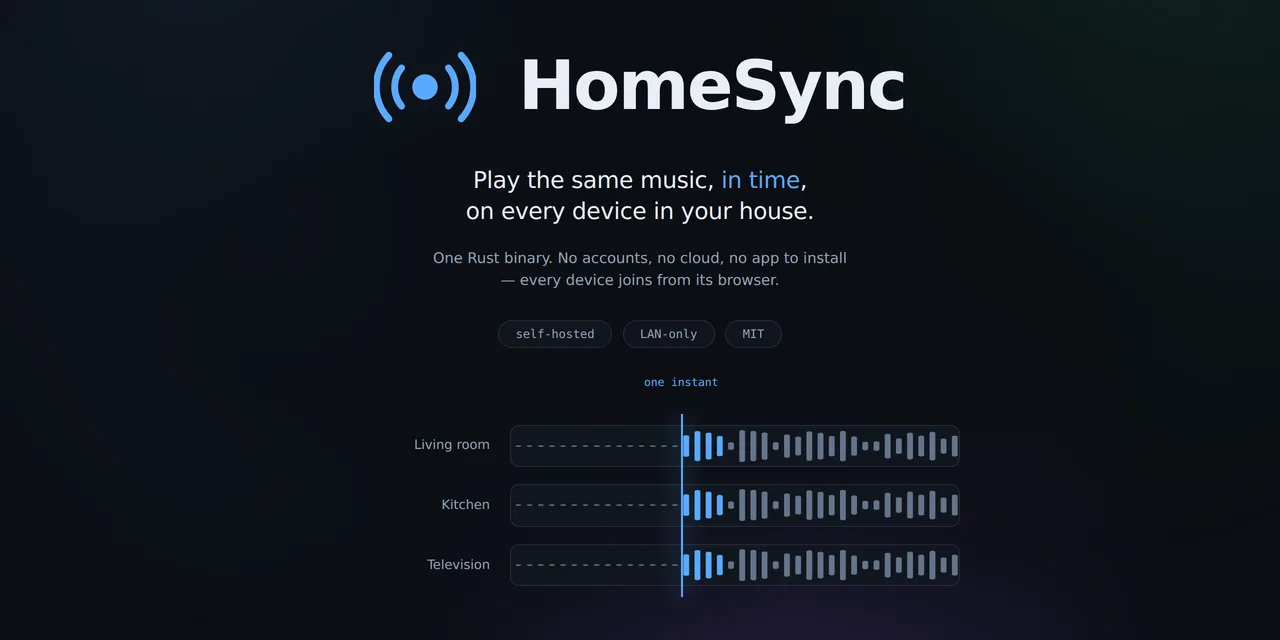
🚀
Home Sync
Play the same music, in time, on every device in your house.
Play the same music, in time, on every device in your house.
Building a dev tool or hiring developers? Get seen here. Become our Sponsor
 King Salomon
 wacxv
wacxv Lixter Niño D. Dinawanao
 Mon Albert Gamil
 Carlo Dandan
 Ruri
Ruri Lewis John Villamor
 Ian de Jesus
 Nico Alumbro
 Joowd
Joowd Kaihzan-Nixxo C. Jamilla
 <JRJDev>
 RCastromero()
 UrAvgProgrammer
 rodge-dev
 exciar
 euphydev
 </Peter> "21st Dev Vinci"
 Benson
 Doctor Scoliosis
 John Javier R. Idmilao
 Michael William Mesina
 JB Benedicto
Same song, every room, in perfect sync. Try it now!
Updates:
Memory — server streams tracks instead of loading them whole. 100 MB track, 4 devices: 429 MB → 43 MB
Network — catalogue no longer resent every second. 300-track library: 56.5 KB/s → 1.1 KB/s per client (51×)
Startup — library scan streams its hashing. 17 MB file: 42 MB → 34 MB peak
Timing slider — now works during YouTube; previously changed the number and nothing you could hear
Security — capped concurrent downloads; bounded a crafted-MP4 scan stall (2.0 s → 0.5 s); patched h2 (RUSTSEC-2026-0258)
Features — house-wide volume, shuffle, repeat, saved playlists
Improvements:
Rounded corners with transparent edges — reads as a card, not a rectangle
Device glyphs (speaker, kitchen, TV) so the three lanes look like different kit
Tighter composition, closing the dead space in the middle
The volume popover now has two sliders — Everywhere and This device — plus mute.
The key decision: the room's gain multiplies each device's own rather than replacing it. Turning the house down keeps whatever balance you set between a loud kitchen speaker and a quiet TV. Mute stays per-device — it means this one goes silent, whatever the house is doing.
Repeat cycles off → all → one on one button.
Shuffle keeps the playing track where it is and shuffles what follows. The order is held, not re-rolled at each advance — a shuffle that picks randomly each time can play the same song three times running. The test asserts the property directly: every track once before any of them twice.
Playlists are named queues that survive a restart (the test kills the coordinator and restarts it to prove it). Stored as content hashes, not filenames, so they keep working when files are renamed or moved, and drop only tracks that genuinely aren't there.
HomeSync — play the same music, in time, on every device in your house.
Synchronised music — every device downloads the same file, verifies it, and plays off one shared timeline
YouTube together — each device runs its own player; HomeSync keeps them lined up
Browser-based — no app, no account, no cloud. Devices join by opening a link or scanning a QR code
One binary — 8.5 MB, self-contained. Runs on a laptop, NAS or Raspberry Pi
Works offline — your LAN, your files, your machine
Quiet drift correction — a device running fast is nudged back by a fraction of a percent instead of restarting the room
Per-device tuning — timing offset and a 5-band equaliser, saved per device, so the late TV and the boomy kitchen speaker each get their own fix
Multiple rooms — kitchen plays one thing, bedroom another, from one coordinator
Honest status — one line telling you whether the room is actually together, and which device isn't
HTTPS and room secrets — invite links, rate-limited joins
Building a dev tool or hiring developers? Get seen here. Become our Sponsor
Ian de JesusKing SalomonDoctor ScoliosisJoowdLewis John VillamorBensonMichael William MesinaJohn Javier R. IdmilaoLixter Niño D. Dinawanaoeuphydevrodge-devwacxvJB Benedicto</Peter> "21st Dev Vinci"Carlo Dandan<JRJDev>Mon Albert GamilNico AlumbroRCastromero()exciarRuriKaihzan-Nixxo C. JamillaUrAvgProgrammer