Spillway
Spillway is a self-hosted gateway that routes your app’s AI requests across providers through one local endpoint.
README
I built Spillway because connecting an app to AI providers often means managing different endpoints, model names, rate limits, and fallback logic. I wanted one local gateway to make that easier to manage and control.
Spillway is a self-hosted Go binary. Your app connects to one local endpoint that supports OpenAI Chat Completions, OpenAI Responses, and Anthropic Messages formats. You can group models into tiers and route requests with auto or spillway/.
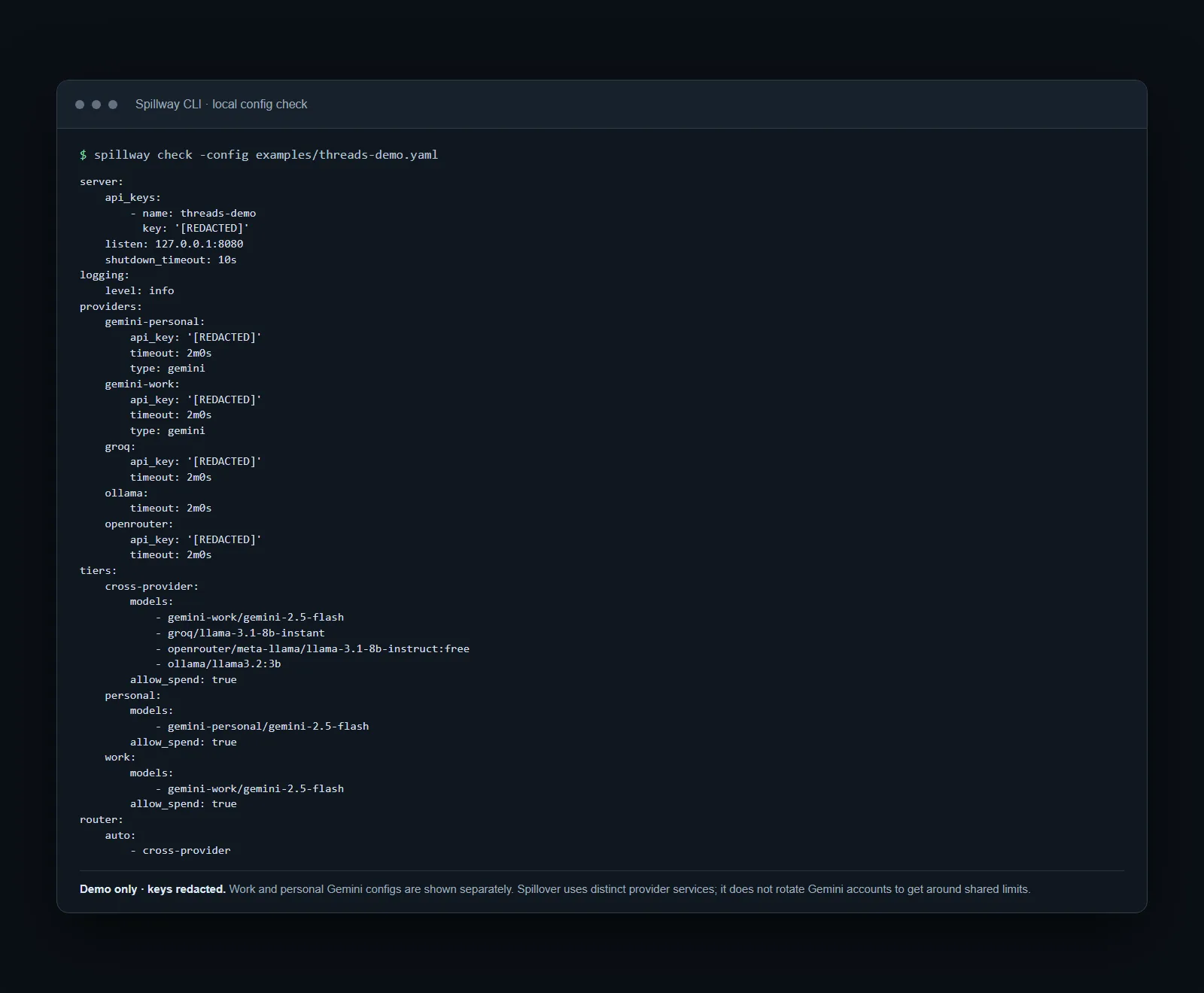
You can give provider configurations names that make sense for your work, such as gemini-work and gemini-personal. If you have five independently authorized Gemini projects and their terms allow it, you can configure five separate entries. The names help organize workloads; they don’t combine those projects’ quotas.
Spillway does not rotate between Gemini accounts or keys to get around shared limits. For eligible tier-based requests, it can spill over to a different provider service, such as Groq. You bring your own keys, which stay local.
Spillway has no telemetry. Optional local features include usage history, estimated costs, budgets, caching, and a dashboard. It’s open source under the Apache 2.0 License. If you build with Go or work on local AI infrastructure, feedback and contributions are welcome: github.com/Polqt/spillway
Journey
No updates yet.