Updates:
Warns about security risks in forgotten projects. Finds known-vulnerable dependencies — even in projects already cleaned up. Nothing is sent online.

Local desktop app that reclaims disk space from dormant dev projects by removing rebuildable artifacts, never source cod
Visit siteBuilding a dev tool or hiring developers? Get seen here. Become our Sponsor
Updates:
Warns about security risks in forgotten projects. Finds known-vulnerable dependencies — even in projects already cleaned up. Nothing is sent online.
Next opportunity: warn about security risks in forgotten projects.
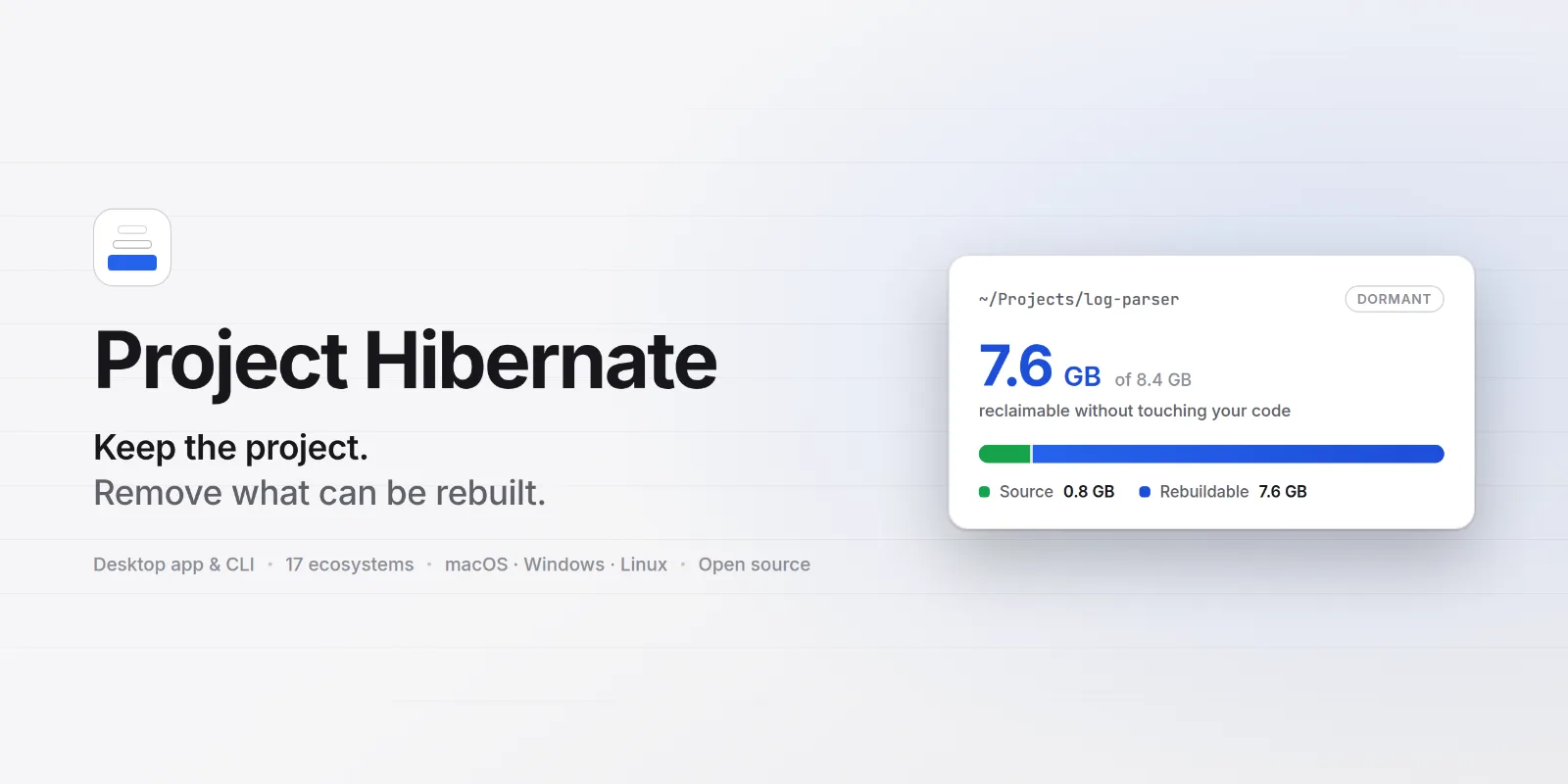
Quick update on Project Hibernate, the tool I’m building to reclaim disk space from projects I’m not actively using.
If you manage 100+ hobby and professional projects like I do, the savings can add up fast. On one of my workstation alone, Hibernate found 89.4 GB I could reclaim.
It doesn’t delete your code. It targets rebuildable folders like node_modules/, target/, .next/, and .venv/, shows exactly how much space you’ll recover, and supports Trash/quarantine with restore.
A Wake command can reinstall dependencies using the project’s own lockfile.
Recently shipped:
• More accurate reclaimable-size calculations
• Git-tracked files are always protected
• Real cleanup safety tests against hostile folders
No account. No cloud. No telemetry. Nothing leaves your machine.
Open source → https://github.com/lewisjohnvillamor/developer-project-cleanup
🚀 Shipped it — Project Hibernate is now live!
Developers who keep many side projects on disk. The kind of person with 50 to 300 folders under ~/Projects, most of them untouched for months.
People who experiment with frameworks. Every abandoned Next.js tutorial leaves behind 400 MB of node_modules; every Rust experiment leaves a multi-gigabyte target/.
Anyone on a small SSD. Laptop users with 256 or 512 GB who hit "disk almost full" and don't know which folder is responsible.
Developers who refuse to delete repositories. They want the source, the Git history and the ability to come back to a project in two years. They just don't want to pay disk rent for its dependencies today.
Not for: server cleanup, CI runners, or anyone wanting a general-purpose system cleaner. It only understands developer projects.
Dependencies and build output dwarf source code. A project whose source is 30 MB routinely occupies 1.5 GB. The ratio is often 50:1 or worse.
Existing tools are the wrong shape. A generic disk cleaner shows you folders and byte counts, leaving you to decide whether target/ is safe. It doesn't know what a project is.
Manual cleanup is tedious and risky. Nobody wants to rm -rf their way through 100 folders at 11pm, one typo away from deleting src/.
You can't tell dormant from active. File modification dates lie: a stale .next/cache written by a background process makes an abandoned project look like you touched it yesterday.
Deleting feels irreversible. Most people would rather waste 90 GB than risk losing something they can't name.
Building a dev tool or hiring developers? Get seen here. Become our Sponsor